
 Media
MediaMathematics has just accelerated by more than an order of magnitude. OpenAI compressed years of potential work into mere hours to discover solutions to challenging theorems.
I am confident that chemistry is next. In university and corporate labs, moving from a chemical hypothesis to experimental results has traditionally required substantial time and coordination. That is about to change so radically that it's hard to imagine what the field will look like in 12 months.
For chemistry to follow mathematics, advances in AI reasoning must translate into experiments, and experimental results must inform what the AI does next. That is the cycle we are building with Maria.
We are witnessing this acceleration firsthand at Molecule.one. It took us only 7 weeks to go from a high-level idea to the near-autonomous discovery of OAI-M1-003 with OpenAI. We estimate that the same project would have taken at least a year using a more traditional approach involving human ideation and less automated experimentation and analysis.
In September and October, the Molecule.one team – operating Maria, our agentic system and high-throughput lab – experienced further acceleration in several areas, such as identifying potentially novel side products and moving from an idea to high-throughput experimentation (HTE).
Our conviction is so strong that we are taking on one of the greatest challenges in chemistry: discovering a highly impactful new reaction class.
And we want to share progress reports along the way.
Why a new reaction class?
A novel reaction class can change the world. It can catalyze research into new therapeutics by making certain molecules dramatically more affordable. A concrete example is the Suzuki coupling reaction. In 2010, Akira Suzuki shared the Nobel Prize in Chemistry with Richard Heck and Ei-ichi Negishi for palladium-catalyzed cross couplings in organic synthesis. Suzuki coupling has simplified the synthesis of many pharmaceutical compounds.
Ever since our discovery of OAI-M1-003, we have been on a very open mission to direct Maria toward discovery of a fundamentally new reaction class. Our expectation is that this agentic discovery will be unique, counterintuitive to humans, and transformative to medicine.
We are pursuing several strategies to discover a novel reaction class. We want to share how work in chemistry has changed and accelerated with agentic AI.
How Maria Identified a Potentially Novel Chan-Lam Tandem Coupling with Just Over an Hour of Detective Work
The first significant acceleration happened in Maria’s analysis of LC-UV-MS data from unexpected experimental results.
Our microliter experiment dataset contains more than 500,000 experiments analysed using LC-UV-MS. This amounts to terabytes of data.
As a result, Maria has an unprecedented opportunity to tirelessly comb through millions of events in the LC-UV-MS data to look for unanticipated reactivity.
We carefully engineered Maria for this task, which is no small feat. It has to search for hours, read gigabytes of data, and follow up on leads like a detective.
Oct. 1, 2026. We launched Maria’s agentic search through our Chan-Lam coupling dataset. The run focused on unexplained events in our experiments. For thousands of reactions Maria looked through the events, assigned probabilities and performed Bayesian reasoning.
After just over an hour of sleuthing, Maria identified an unexplained peak in R0402359 with m/z 263 at 0.805 min. After finding other examples of the same ion, Maria gained confidence that this could reflect a repeatable chemical process:
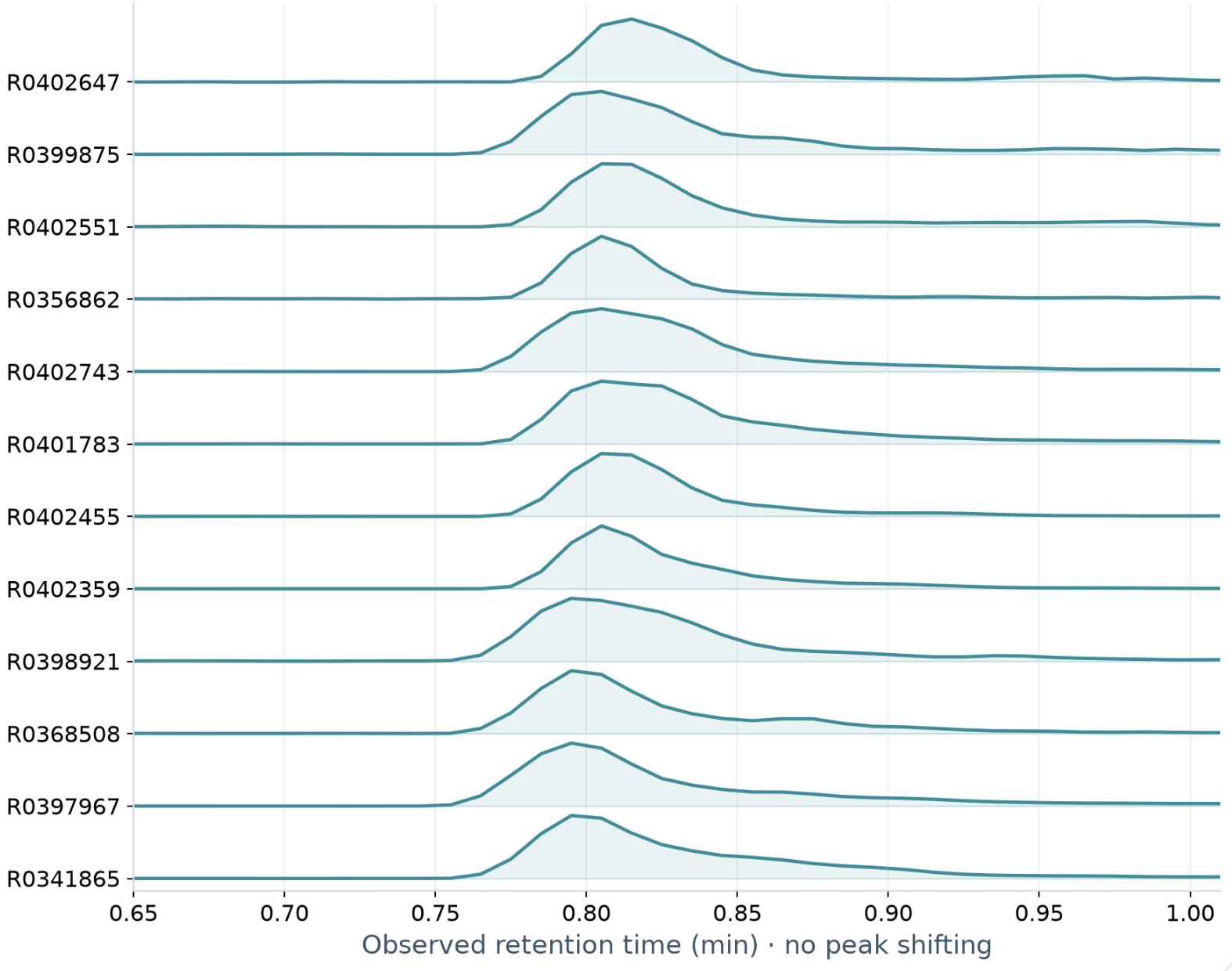
Just identifying a peak is not enough. Maria then proposed a possible product structure arising from an intramolecular cyclization, which we refer to as M1-002, shown below.
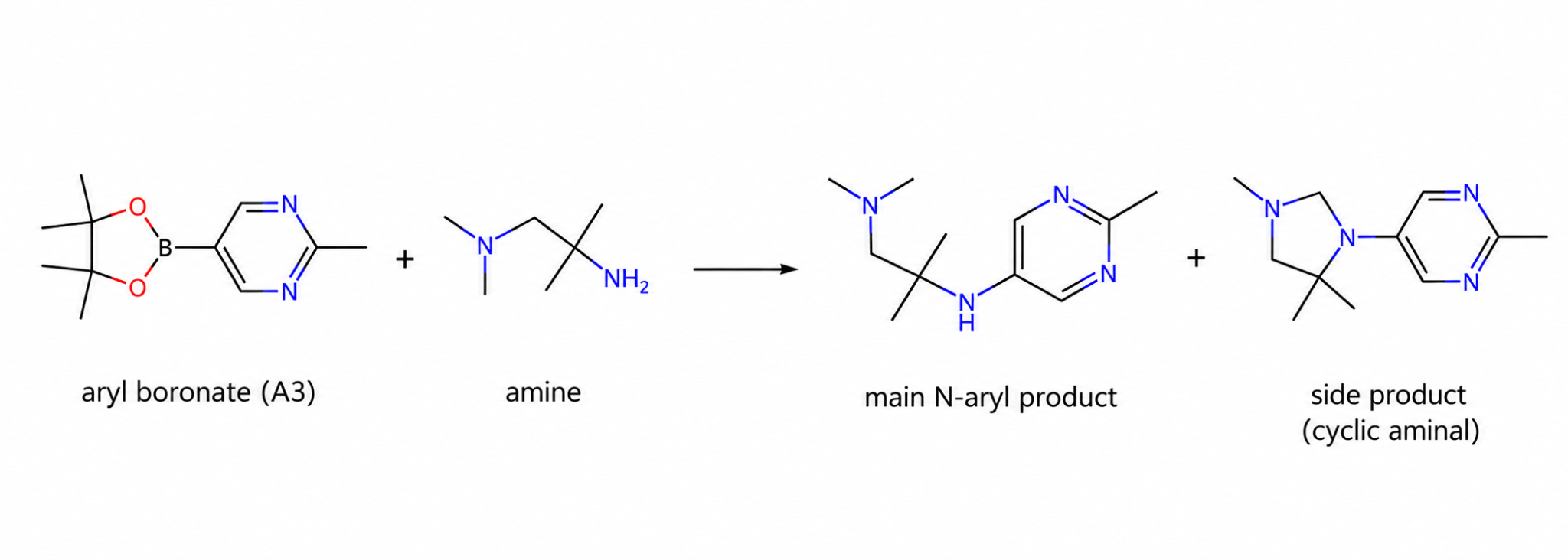
Our team found this product worthy of further investigation. Many valuable molecules have complex rings that are hard to make through coupling reactions, and here we had observed a possible way to achieve that in a one-pot coupling reaction. If we can confirm this finding, we will have found a path to shorten the synthesis process of compounds with these ring structures and open them to biological research.
Next, we needed to test whether the signal could be reproduced at a larger scale, using more familiar bench chemistry.
Oct. 5, 2026. We used Maria to design an experiment to validate the reaction manually on the bench. This involved calculating amounts of reagents, checking internal inventories, and proposing the overall experimental design. This took Maria minutes, whereas it would have taken our team hours.
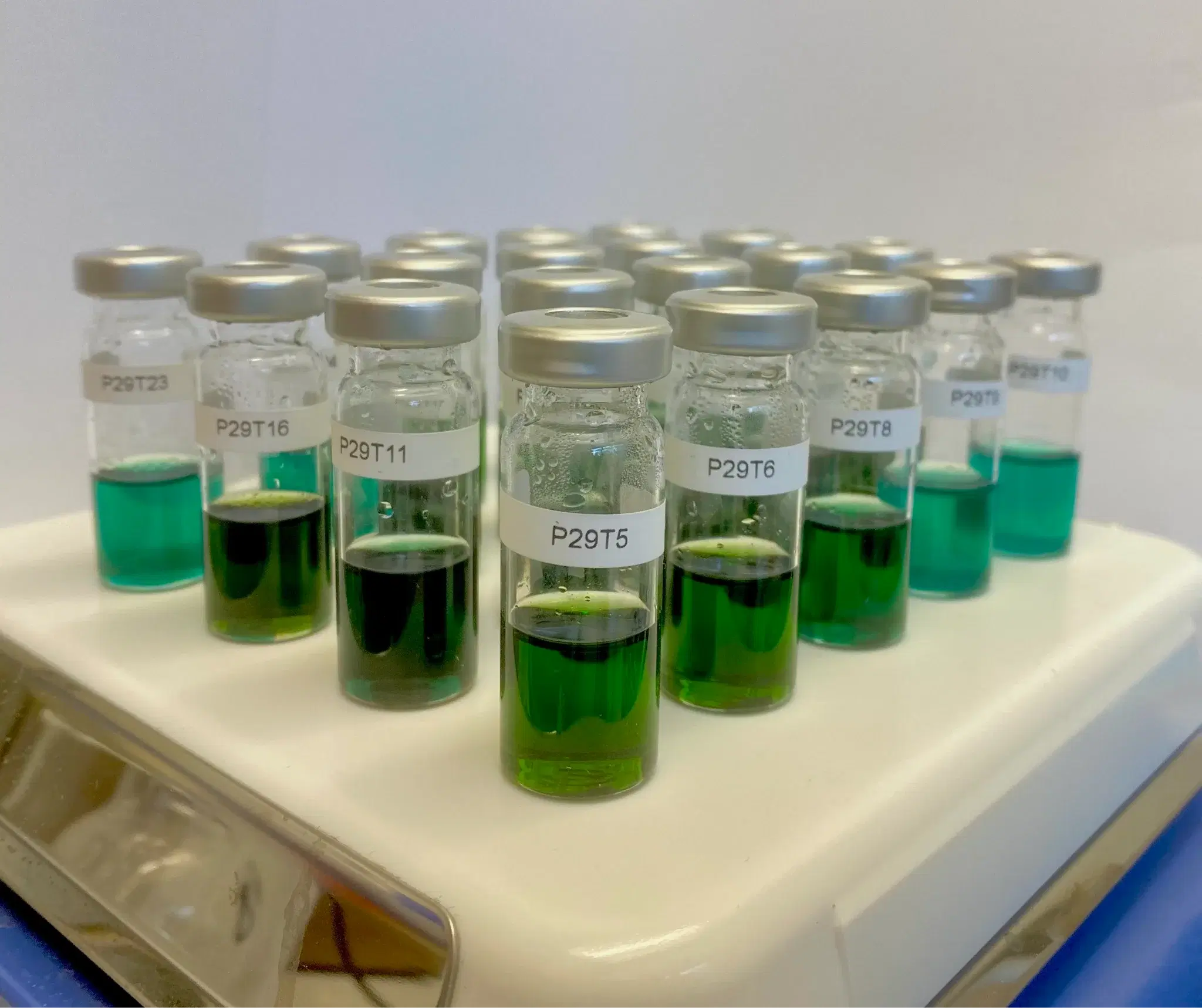
Oct. 8, 2026. Our human chemists carried out experiments at a larger scale to assess whether the observed signal depended on the HTE setup. The image below shows vials from these larger-scale experiments.
Oct. 12, 2026. Maria agentically analysed the data from the bench experiments using our proprietary software and confirmed that the m/z 263 signal was reproduced. The image compares the original signal (purple) with the reproduction from Oct. 8 (teal).

We are still in the process of confirming the molecular structure of the product using NMR. But the early signs are encouraging.
The search was fully agentic and took just over an hour. Between Oct. 1 and Oct. 12, we went from a broad search to reproduction of the analytical signal at bench scale. Structural confirmation is ongoing.
This advance brings us closer to the goal of discovering a novel reaction class. Our key approach is what we call engineered serendipity: systematically searching for unexpected chemistry in experimental data. We believe clues to the next impactful reaction class may already be hiding in massive high-throughput experimentation datasets like ours.
From a High-Level Idea to an Executed High-Throughput Campaign in Four Working Days
Another strategy is to test new ideas for a novel reaction class generated by Maria.
Last spring, we worked with OpenAI to engineer a GPT-Maria system that could rapidly generate and validate chemical hypotheses. That led to the discovery of OAI-M1-003.
Following that project, our emphasis has been to improve the novelty of the ideas that agents generate and can test in the lab. We are seeing significant acceleration of these timelines, even compared to the OAI collaboration.
Oct. 9, 2026. We decided to test a new high-level idea for a new reaction class produced by a frontier LLM and Maria.
Going from a high-level idea to plans executable on a high-throughput platform takes days, if not weeks, of human time. The process involves complex planning, defining the substrate scope, checking inventory, ordering reagents, and writing Python code.
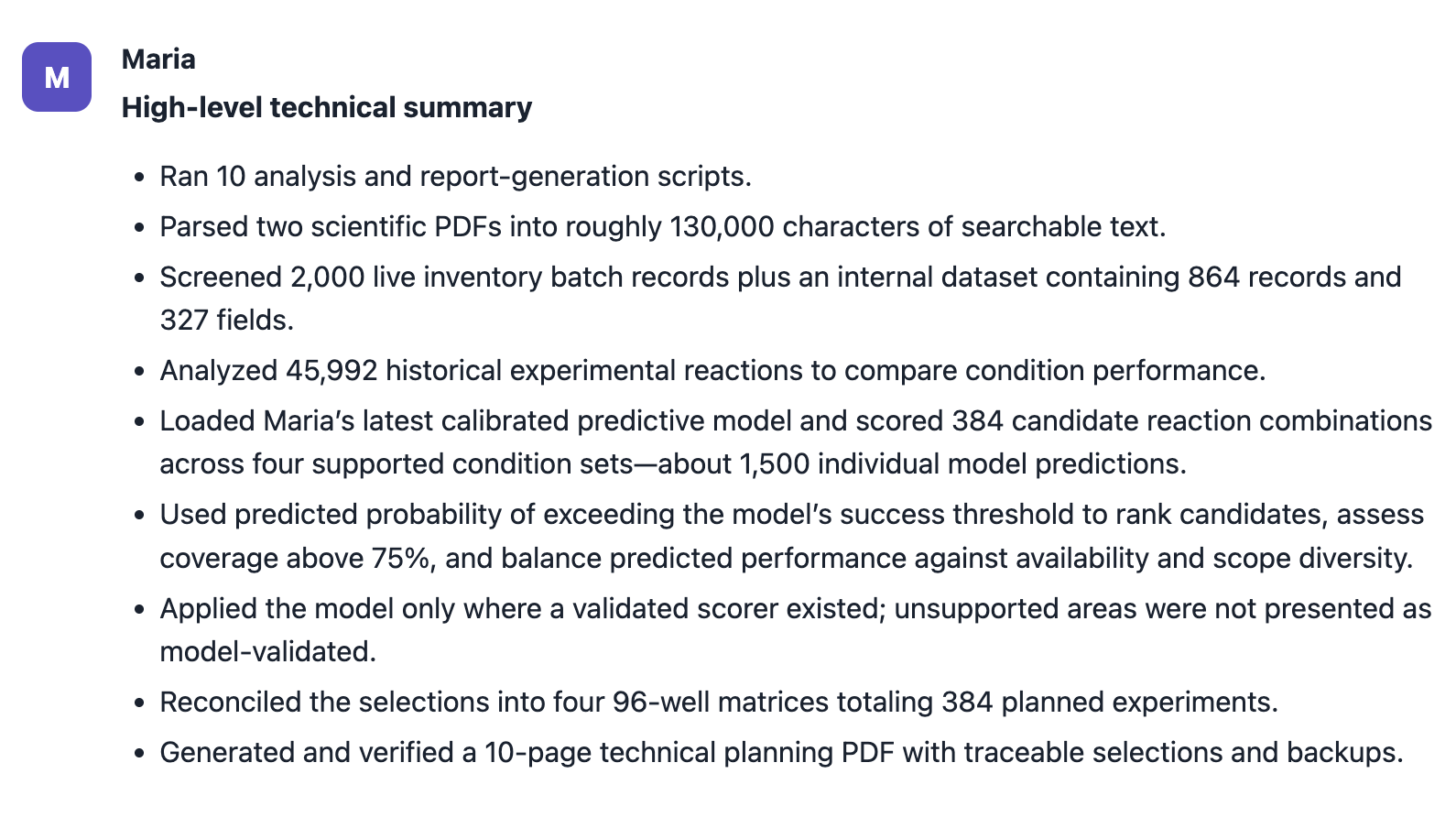
Oct. 12, 2026. We used Maria to carry out the analysis and detailed experimental planning. Maria worked agentically for 30 minutes and produced a plan for 384 experiments across four 96-well plates. Here is her summary of the work:
Oct. 14, 2026. Maria ran a large HTE lab screen in near-autonomous mode. That was yesterday. We will keep you posted about what happens next.
The sequence of events from Oct. 9 to Oct. 14 represents extraordinary speed.
Conclusion
We are sharing a snapshot of our journey towards discovering a new reaction class with agentic AI. We hope you find this as exciting as we do.
We are very optimistic that this goal of discovering a new reaction class is achievable and will usher in a new era of chemistry similar to what is already unfolding for mathematics.
Stay tuned for more results!
 Back to Media